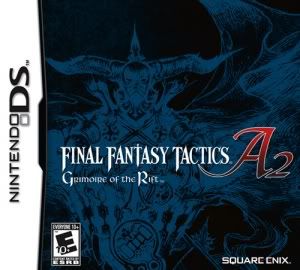
 As a genre, tactical RPGs are a pretty specialized bunch and are aimed at a specific audience of followers. The original Final Fantasy Tactics was one of the greatest examples of this style and a game to which most that came since have been compared to. In a sense, Final Fantasy Tactics A2 falls short of its esteemed predecessor but is still a very strong game with plenty of enjoyment to warrant your investment.
To get right into it, the story in FFTA2 is its weakest point. It it a light and unexciting tale about Luso Clemens, a schoolboy in the real world (our world) who gets transported into the pages of an exotic book. This lands him in the world of Ivalice, the setting used for Final Fantasy Tactics, Final Fantasy Tactics Advance, and Final Fantasy XII. The overarching goal of the game is for Luso to return to his own world but there is no urgency or serious motivation to do so. Even the other goings-on that occur along the way lack any true seriousness or gravity. Perhaps the whole "save the universe" concept so prevalent in RPGs (especially Japanese RPGs) has gotten rather cliche but it sure lends a sense of importance to the events which are happening. Additionally, with the focus on a child as the main character there is a further disconnect for an adult player such as myself. Perhaps Square-Enix is trying to reach out to a broader audience with that decision but I don't think there are a lot of schoolchildren playing tactical RPGs.
Fortunately, the gameplay far outshines this weak story. Of course the main focus in most any tactical RPG is tuning your army and fighting battles and in FFTA2 those elements are wonderful. The class based system used in the previous FFT games is still here and is the best part of this title. You can chose a class (or job for us old-schoolers) for each member of your clan which decides what abilities that individual can learn and also determines some of their basic stats like movement, speed, and evasion. There are a total of 56 classes available, broken down by 6 different races (although it's important to note there is some overlap of abilities and unit types). Not all classes are available to start though, there are some races of units which only become availabe under special conditions and the more advanced classes have prerequisites of minimum ability levels in the more basic classes.
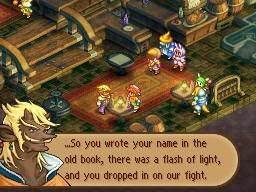 How you actually learn abilities is by wearing equipment imbued with those abilities, with most equipment holding two or three abilities that certain classes can use. By wearing that equipment and being the correct class you immediately gain access to that ability. The longer you wear that equipment while in battle you gain ability points towards learning that skill. Once you earn enough ability points that unit can then use that skill even when not wearing the equipment. (This mechanic should be instantly recognizable to Final Fantasy veterans.)
The best part of this system is once you learn an ability you can even change classes and still have access to equip skills learned under a previous class. Each unit can equip two class action ability groups (such as the White Mage's white white magic abilities or the Soldier's pugilism actions), one reaction ability that triggers when attacked (like counter or regeneration), and one general support ability, (like attack up or turbo MP). This allows for an insane amount of customization once a unit has learned enough abilities. For example, by the end of the game my most powerful unit was a red mage with doublecast (two consecutive magics in a turn), summoner ability, and the blood price support ability (spells cost HP instead of MP at double the price).
The battles in the game are varied and abundant. In addition to the main storyline events your army, or clan, can take on an almost countless number of side quests by accepting jobs at the local pub. A surprising aspect of this is that far from being just throwaway distractions most of these quests had small storylines all their own with recurring characters and consecutive jobs which built upon the prior. For the most part, battles present a decent challenge but the game as a whole felt on the easy side and left me longing for the challenges present in some of the original FFT battles. Thankfully there is also a Hard mode selectable when you begin the game and in hindsight I wish I would have selected that myself. My one gripe about the battle system is that on occasion the enemy AI makes some idiotic choices. This ranges from a wasted turn trying to inflict a status ailment on a unit immune to that ailment to mages with low HP effectively committing suicide my walking up to a fully armored knight with counterattack ability and hitting him. Thankfully these type of things occur only rarely.
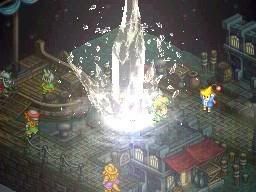 All of this is wrapped up in a very attractive and polished package. The entire game is presented in 2D using well detailed sprites and backgrounds similar to FFTA. However, an impressive upgrade when compared to its predecessor are the spell and ability effects, some of which light up the whole screen with dazzling displays. Being a DS game, the expected touch control is available but it is in no way necessary and I suspect the vast majority of players will skip it all together. Music is very well done and features themes taken from FFXII along with original compositions.
In summary:
+ Beautiful 2D graphics and effects.
+ Expansive selection of unit classes and customization.
+ Huge amount of gameplay.
+ Highly polished presentation.
- Immature and non-engrossing story.
- Occasional poor AI decisions.
- Not all classes are available to start.
Overall FFTA2 is a worthy entry in the FFT series and the tactical RPG genre as a whole. While I still long for the mature storyline and difficulty which was found in the original there is still plenty of deep and engrossing gameplay to justify the easily over 100 hours investment available here.