Monday, January 12, 2009

Valkyria Chronicles Review - PS3

Wow, it looks like I've been absent for a few months but after a long delay I finally have a new review.


First off, let me say that I think game demos are a beautiful thing. With next-gen games running about sixty bucks at the checkout counter it's a pretty big investment to plop down on something that just might not click for you, no matter how many reviews you read (perhaps I will share my GTA IV experience at another time). That is why after reading about Valkyria Chronicles and becoming intrigued, I was happy to see a demo available in the Playstation Store. I downloaded it, played it, and thought these guys were really on to something. So I put it on my Christmas wish list and was very pleased when Santa (a.k.a. my wife) surprised me with it on that day. I have now had a chance to complete the game and I'm happy to say that the demo is no fluke and only hints at the great experience of the full version.

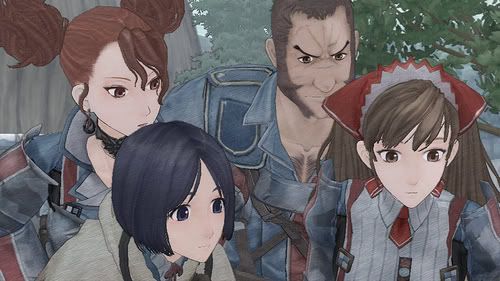
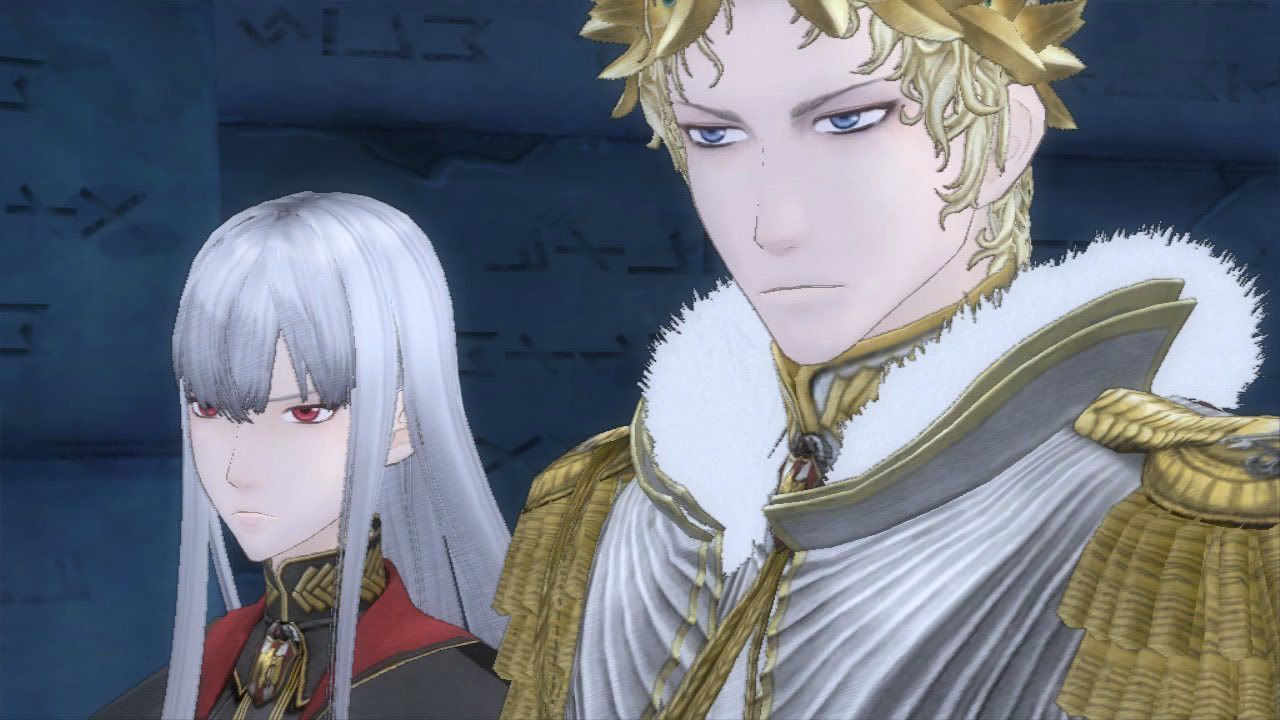
Valkyria Chronicles is all about the struggles of the country of Gallia, a small nation caught between the huge opposing sides of the Federation and Empire during Europan War II. EWII is an analogue to our own WWII but in this altered universe there exists a mineral called ragnite. Ragnite has many medical and scientific uses but he majority is used as fuel. It just so happens that Gallia is rich with the stuff and when the opposing war factions begin running low on resources they set their sites on the neutral country. The game does an excellent job of dealing with many heavy subjects like war, casualties, racism, and massacres without becoming oppressive and dark. This isn't achieved by artificially glossing it over though, instead it simply focuses on the hope and drive present in the main characters and the way they band together to pull through. Through the game you follow Squad 7 of the Gallian militia and take command of their role in the war. It is a good story which, while often predictable, stays interesting through to the end and does hold a few memorable moments. Also of note is while you are commanding a whole squad of units with many possible members, each one had a very distinct personality which easily shines through. By the end of the game I actually felt a certain attachment to most of the squad members that I used regularly and would refer to them by name with my wife as she watched me play.
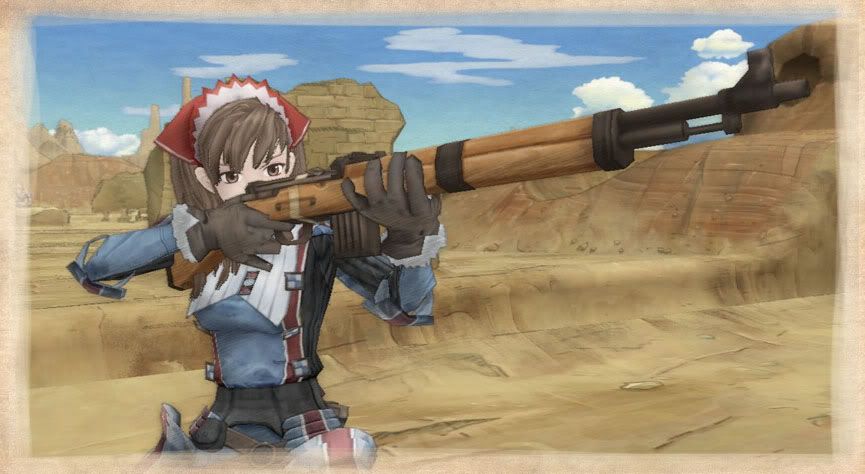

When actually playing Valkyria Chronicles the first thing that will hit you are the graphics. This game is beautiful. The experience is presented in the context of a book detailing the history of the war and the art style reflects that perfectly. Everything has a wonderful hand-drawn look to it and is colored in a vibrant water color style. Almost everything is rendered in the real-time graphics engine and I would have to say this is the first game I've ever played where the pre-rendered CG cinematics look worse than the in-game graphics as they lose some of the distinct black line edge that makes the normal graphics come across so well. Added to this overall presentation are comic book style onomatopoeias added for certain sounds ( for example vrooooom drifts up from a tank's engine). While some I've talked to find this unappealing I thought it was never intrusive or overused and helped to maintain the overall lighter atmosphere conveyed by the graphics, especially when dealing with the serious subjects mentioned earlier.
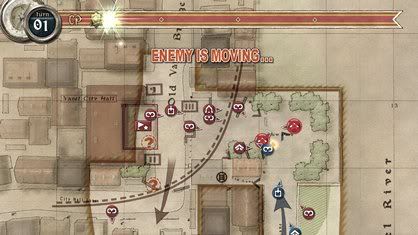

The second most striking feature of the game is the gameplay itself. Valkyria Chronicles is such a unique game that it could arguably be called it's own genre. While I would say it's most accurately described as a strategy RPG it also has a healthy dose of 3rd person shooter thrown in. For battles, you are presented with a tactical map representing the battlefield and the positions of any enemy units which your units can see. You have a certain allotment of command points on each of your turns which you use to take command of your individual units or issue battlefield "orders" which are basically commander level special abilities. When you take command of one of your units the game literally zooms down into the tactical map and you control that unit. There is an AP gauge on screen that depletes as you move the unit and you can only take one action (such as shooting, healing, etc.) which limits what you can do in one turn, however, you are in complete command of that unit. It is up to you do dodge enemy defensive fire (called intercept fire) as you run about the battlefield and line up your shots. Thankfully things never get to extremely intense since when you pull up your gun to aim the game essentially pauses, allowing you to breathe and line up the shot you are looking for. It all comes together beautifully in a way that I think can appeal to more action driven shooter fans while not alienating traditional SRPG fans like myself.
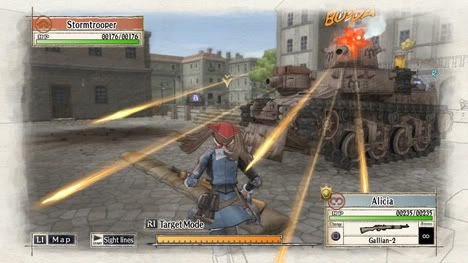

There are many different unit type to choose from when selecting with squad members to take into battle, all of which are very diverse with complex interactions. First and foremost, your tank serves as the backbone of your army and a mandatory inclusion on any mission. It deals the most damage, is invulnerable to standard enemy bullets, and can even provide cover your other troops can hide behind. The drawback is it takes two command points to activate (versus one for any other unit) and has a vulnerable spot in the rear which if not protected can lead to a one shot kill (consequently an instant game over). The rest of your unit types have their own strengths and weaknesses. Scouts have a huge movement range and good field of vision for spotting enemies but have low defense and low firepower rifles. Shocktroopers are heavy assault units with powerful machine guns and resistance to enemy gunfire but have very short movement range. Lancers are a mobile artillery unit with powerful anti-tank rocket lances but are slow with somewhat limited movement range and no counterattack or intercept firing ability. Snipers have zoomable scope rifles capable of one shot headshot kills but have the lowest movement and weakest defense of any unit along with no defensive firing. And lastly, Engineers are a support unit with low firepower and defense but many indispensable abilities such as repairing tanks, disarming landmines, and rebuilding defensive structures like sandbags, barricades, and sniper towers. Taken all together it is much more than a simple rock-paper-scissors setup which offers a nice depth of strategy and normally more than one way to complete an objective.

Though something of a hybrid game, the RPG elements are still well represented in Valkyria Chronicles. Based on your performance in battles you earn experience which can be spent to level up your units. With over 30 possible units in your squad, a nice inclusion for streamlining this process is that you don't level the individual units but the different class of units instead. So if you spend your experience points to level up your scouts, all scouts level up. In addition you earn money from your battles which is spent to upgrade your equipment. For the most part, this is handled in the same way as your experience so once you purchase an upgraded sniper rifle it's automatically equipped for all snipers. There are some exceptions though where you will receive special rewards of unique equipment which you can then choose to equip on specific individual. There are also additional customization options for your tank including the addition of extra parts that take up certain block sizes and must fit together within limited space (think inventory management in Diablo).

Last but not least the game sounds terrific. The music is of the basic orchestral variety but is varied and does it's job well. Voicework is mostly wll done with only a few exceptions and is put to especially good use as each squad member has their own voice responses which really bring additional personality to each of them. Overall, though, the sound effect presentation is what really stood out to me. When you are zoomed out to the tactical map you only hear the background music but as soon as you take command of a unit and the scene zooms in you hear the battle all around you. The rumble of tank engines, crack of enemy gunfire, and even the occasional radio transmission from either side are all presented in terrific surround sound to really draw you into the moment. It's just another element of the great presentation and attention to details found within the game.

In Summary:
+ Beautiful and original graphical presentation
+ Innovative and exciting gameplay merging two distinct genres
+ Wide unit variety with complex balancing
+ Distinct unit personalities conveyed well through abilities and voicework
+ Serious and deep story elements handled without oppressing gloom
- Sometimes predictable story

As you can see here, there really isn't much negative that I can say about Valkyria Chronicles. In a time where most companies rely on bankable sequels this is a great original game which really drives the SRPG genre forward with it's innovation and is all wrapped up in a beautiful package. Valkyria Chronicles comes highly recommended.

Tuesday, October 7, 2008

Crisis Core: Final Fantasy VII Review - PSP

I must preface this review with the statement that I'm a huge fan of Final Fantasy VII. I started playing Final Fantasy with the first game on the good ol' NES. When Final Fantasy VII came out it was essentially the reason I bought a Playstation. I remember seeing a commercial for VII and just being blown away (both by the content of the commercial and the fact that it was a commercial for a video game, you just didn't see that back in the ancient age of 1997). Although the game might be a bit dated now, at the time I was totally sucked in and became a fan for life. I lay this out there because, in essence, Crisis Core is aimed specifically at me. It is the hands-down best part of the "Compilation of Final Fantasy VII" it is aimed squarely (no pun intended) at fans of the series and oh boy, does it ever deliver.

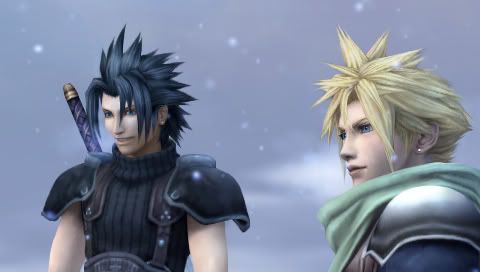
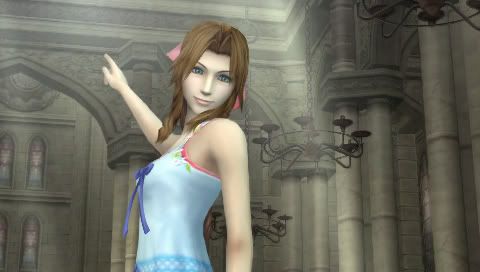
Crisis Core is the story of Zack Fair. Zack is a member of SOLDIER, the elite paramilitary force belonging to the mega-corporation Shinra Electric Power Company. The game begins with Zack simply wanting to rise to the top of the ranks and become a hero. Of course, things never stay that simple in a Final Fantasy game and Zack end up faced with some ethically questionable situations and having to stand up for what is right in defense of the innocent. The universe of FF VII is quite in depth and at times rather confusing but overall Crisis Core does a good job of explaining everything and not delving too far into total bewilderment. Crisis Core is a prequel to the events of FF VII so fans of the series will get to meet up with many recognizable faces throughout the course of the game. You also get a lot of additional backstory on some of the most prominent characters from VII. One of the downsides to this, though, is while the story is great up to a point it ends up waxing on too long towards the end. The emotional climax of the whole game comes during an extremely memorable event which was seen as a flashback in FF VII. It is such a powerful scene but afterward there are still two more chapters where the story (almost literally) limps along until the actual conclusion. This ultimately left the overall experience lacking some of the really strong emotional impact it could have had.

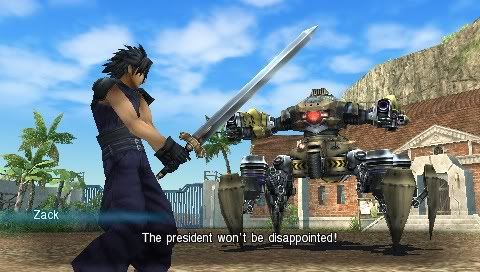
One thing that simply cannot be denied about Crisis Core is the game is absolutely beautiful. It shows that the PSP truly can pull off an experience that you would find on a PS2 while on the go. Everything from the menus, to the animations, to the character and enemy models are all top notch. I was also stunned by the FMV movies included. They look absolutely beautiful and there are a surprising number and length to be seen. In addition, I cannot give enough recognition to the sound work in the game. Voiceovers are well done as are the the sound effects (many of which are a perfect homage to FF VII). To top it all off the music is simply incredible. You get not only a great assortment of updated FF VII themes but also many new original tunes, a couple of which I found myself humming in between play sessions. This is the only portable game I have ever played where I felt compelled to play only with headphones so I could truly experience it all. The entire presentation of this game leaves nothing lacking and everything speaks of an extremely high standard.

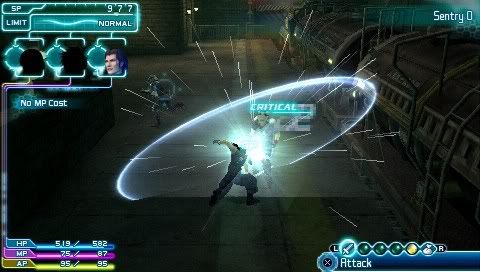
As far as gameplay goes I'm not normally much of a fan of action RPGs but I found myself really getting into Crisis Core. You cannot see enemies as you run around the areas but instead battles occur randomly at predetermined points where there is enough room to fight. There is a seamless transition into combat as the enemies materialize and attack (along with a lovely voice announcing you are entering combat mode). It works quite while still being a cool nod once more to VII and its random encounters.

One disappointment I found is that while there is a very wide array of equipment to be found, most of it not really worth equipping. A lot of what you find will be easily outclassed by something better. For example, once I found an item that gave me +10 Attack, +10 Magic, and immunity against silence the three other items I had with just a single one of those abilities were imediately obsolete. To make it worse, with only two equipment slots to fill your two best pieces are going to be worn throughout while everything else you find just piles up.

To provide Zack's spells and combat abilities there is an interesting materia system in place which ties nicely into the FF VII vibe. While it gets the job done, its not nearly as fun as its inspiration. Whereas VII allowed practically limitless combination of skills and spells through a linking system there is none of that to be found here. Instead it's replaced with a materia fusion system where you can combine two materia to create (hopefully) new kind of materia. Unfortunately, this process breaks down to simply hit or miss as there is no clear method to the system. While you can see what the result will be before actually making your combination you still must go through the trial and error of checking all your various combination to see what the possibilities are. This becomes a very tedious process as you end up with several inventory screens worth of materia during the course of the game. I personally gave up on it after I got the essential abilities I felt I needed - healing, long range magic, and an area attack sword swipe.

That ties into one of my minor complaints with the combat. You really only need those few combat abilities to get through the game: your basic attack, a magic spell for long range, an area attack for when you get mobbed, and healing for the purpose of, well, not dying. That said, your basic sword attack will be what you 75% of the time because it has the best balance of power and speed. Every other specialized attack ability comes with varying lengths of delay to use it, normally meaning you get pummeled before you can actually get it off. Don't get me wrong, combat is still quite fun using just those four things, but it would have been nice to have a few more useful toys to play with.

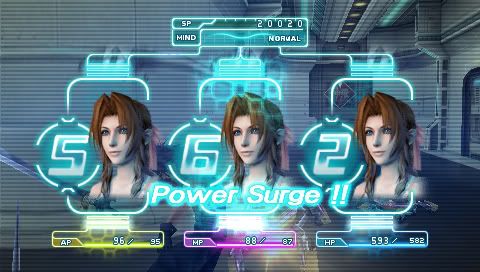
One of the most innovative and interesting elements to Crisis Core is a thing called the Digital Mind Wave. It's essentially this game's version of a Limit Break system. The DMW is a slot reel of character portraits and numbers that constantly spins in the corner of the screen while in combat. If the numbers match in certain combination you are granted a minor buff for a short time. When the party really gets started though is when two of the portraits match. This then switches the reel to full screen to see if you get a third matching portrait. If you do, Zack performs a "limit break" relating to that character. In addition, you also are sometimes treated to a small cutscene relating to Zack's relationship with that person. I find this to be a very cool idea and ties into the game in the sense of reflecting what Zack's thinking of while fighting. Also, while you cannot directly control the system it's not wholly random either. While playing, it is clear that the game does influence the probability of the reels depending on the situation, i.e. when you're in a big fight, you're going to get a lot more limit breaks than you would otherwise.

The final feature of the game I wanted to mention is the mission system. Anytime you are at a save point you have the chance to take part in a huge set of side missions to build up items and experience. While they are interesting to start with and are the source of the best items in the game, they are also quite tedious. For starters, the same few areas are recycled over and over throughout the hundreds of missions available. While this is only practical when facing 300 missions it gets boring real quick. In addition, the goal of all the missions is pretty much the same: find the boss monster and kill it. And finally, the missions do not even tie into the main story of the game. Really, I could have done without these altogether and would have like to see the time added to the main story instead. As they are though, they do add many hours of additional gameplay for anyone willing to slog through them all.

In Summary:
+ Beautiful graphics and top-notch presentation all around
+ The best music I have ever found in a handheld game
+ Tons of fan service for any FF VII buff
+ Smooth and enjoyable combat
- Anti-climactic story that misses some emotional impact
- Low level of practical customization with equipment and abilities
- Trial and error materia fusion system
- Highly repetitive side missions


Overall, Crisis Core is a very good game, just not without its faults. There is enough fan service here that any FF VII aficionado should pick it up without question. Several times I even experienced a very strange sense of deja vu as I explored in 3D the same areas I had only seen as pre-rendered backgrounds in FF VII (yes, it's that spot-on). For the average gamer, though, I still recommend Crisis Core as it is a fun game with a good story that shows off the power and style that is possible on the PSP.

Tuesday, September 16, 2008

Rocketmen: Axis of Evil Demo Review - PS3


One might wonder when is there actually reason to review a demo of a game. After all, isn't the purpose of a demo that someone can try out a game before committing money to a purchase? Well there is still a minor commitment of time and hard drive space when it comes to downloading and installing a demo. In addition, it does take at least a little bit of time to play through the demo itself. So I would say that a demo review probably means either the demo is so great you have to run right out and try it now or it's so terrible that it's not even worth the time taken to download and play it. Unfortunately, in the case of Rocketmen: Axis of Evil, it's the latter.

The first thing you are taken through in the demo is creating your character. There are several attributes taken into account when making your character, however, there is nothing to inform you what those attributes actually do. Thus, you are left just blindly assigning points based off of what you think might be beneficial with no indication how it actually affects the gameplay.

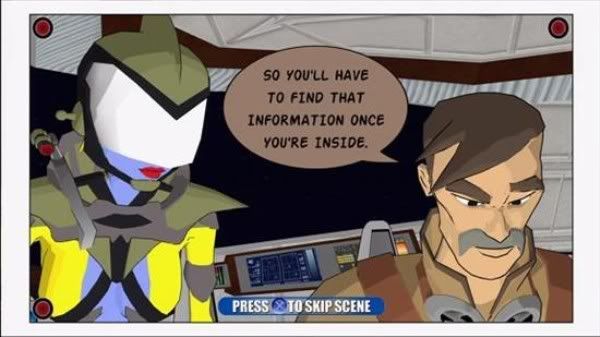
The next thing you are confronted with are the cutscenes which introduce you to the story. The game aims for something like a cheesy 50's era sci-fi feel but it just comes off very poorly. The voice acting used is terrible... really terrible. I have seen YouTube videos with better voice work. The cut scenes are also presented in a pseudo-comic book sort of way with animation separated by frames. While this can be an excellent method of storytelling (see Folklore) here it is just pointless. The frames and onomatopoeia emphasized sounds are simply frivolous additions. Finally, the cel-shaded graphics used to presumably help pull off the comic presentation are poorly done as well. I have seen much better on Dreamcast Jet Grind Radio than what's presented here.

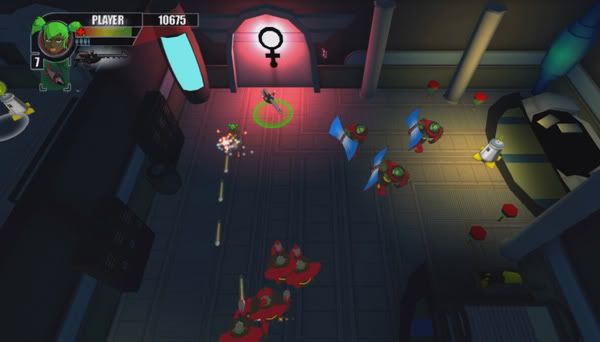
Finally we come to the actual gameplay itself. Rocketmen is at its core a top down run-n-gun shooter presented in a sightly isometric view. There are a few problems with how this is handled though. The camera is zoomed in so far and you have to get so close to the edge of the screen to get it to move that often you find yourself jumped by enemies who were hiding just offscreen. There is a decent variety of weapons presented and some hints of more good ones be found. In addition the game presents a very promising amount of character leveling and customizability. In all, though, it's really just not enough to save the overall experience. After all, who wants to try and level their character further when the gameplay and presentation stink as bad as they do.

In Summary:
+ Promising amount of character leveling and customizability
+ Interesting weaponry
- Nothing to indicate the effect of character attributes during creation
- Terrible voice acting
- Completely ineffective comic book style cutscene presentation
- Awful camera movement
- Poor cel-shaded graphics


Over all, the Rocketmen : Axis of Evil demo isn't even worth the time and hard drive space required for the download. Just skip it - you'll be happy you did.

Tuesday, September 9, 2008

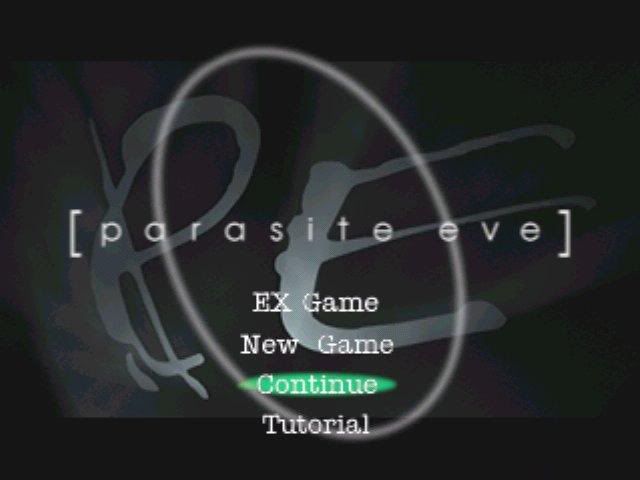
Parasite Eve Review - PSX

I recently bought a PSP and I must say that I am very happy with the purchase. Even though the hardware is now over 3 years old, when holding one in your hands it still feels like a piece of next generation technology. One of the side benefits I was looking forward to is also the fact that, with a bit of tinkering, the PSP is able to emulate a variety of game systems, including the PS1. Because of that ability I got a chance to revisit a game which I had started playing almost 10 years ago but never finished. I finally played Parasite Eve all the way through while on the go and discovered that, for a 10 year old game, it's still a lot of fun.

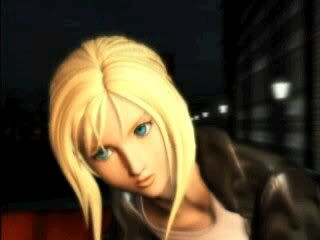
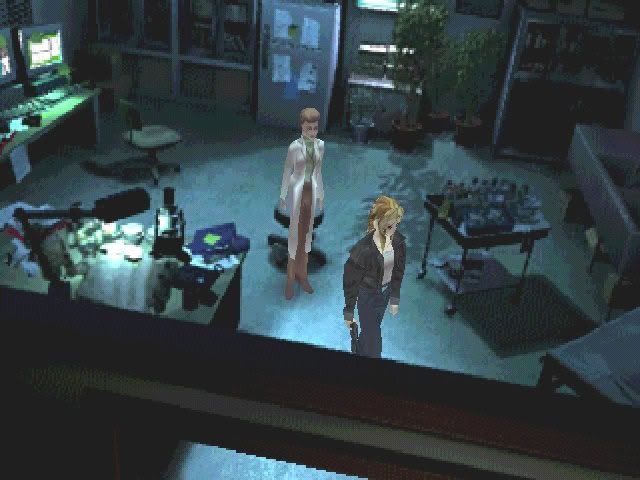
Parasite Eve is the story of Aya Brea, an NYPD officer who is the sole survivor of a paranormal massacre in the middle of New York City. Aya finds herself tasked with stopping the monster responsible and along the way tries to discover why she's the only one apparently unaffected. The story unfolds in a very cinematic presentation both using the in-game engine and rather liberal FMV sequences that still hold up pretty well after so many years. One downside is there is no way of skipping the cinematic sections, so while they are pretty and effective, on a second run through it can be rather annoying.

Although most closely defined as an action RPG, Parasite Eve is actually somewhat an amalgamation of a few different genres. The character's leveling up, use of spells and items, and an active time battle system are all very traditional RPG elements. In addition, although the combat is action oriented in the sense that you run around your enemies avoiding attacks in combat when it is your turn to act the action button stops time, allowing you to select your target(s) for attack or the use of spells/items at your leisure. And finally, the music, environments, ammo conservation, and most of the enemy types are all quite reminiscent of a survival horror title. These elements all mesh quite well to make a game that while engrossing and somewhat action oriented, still allows plenty of time for strategy and isn't simply based on twitch reflexes and button mashing.

When it comes to the story, always an integral part of any RPG, Parasite Eve is a little hit and miss. It does a respectable job of explaining the magical/paranormal events which are occurring in a realistic modern day setting. However, some of the pseudo-scientific details can end up quite confusing and unnecessarily convoluted. Unfortunately, this game also falls into one of the most common pitfalls of Japanese RPG's from the late 90's - stereotyped characterization. Whether through translation or design, many of the character's are extremely cliché (the big, gruff black guy; the timid, nerdy Asian scientist; the idiot kid). One saving grace is that the main character, being a female cop, is actually quite non-stereotypical. Aya is strong, confident, and decisive while still retaining a realistic level of femininity. This is a plus which makes it a little easier to overlook the shortcomings of the other characters.

The graphics used in the game allow it to still look quite good (especially on a small screen) 10 years after it's release. I was always a fan of Square's use of polygonal characters on a pre-rendered background in the PS1 days and that's used to full effect here. Since the backgrounds are all pre-drawn they look very nice and have aged quite well. One minor annoyance that results from the static backgrounds is that the running angles assigned to the d-pad are not always the same for each scene. It sometimes takes a moment to orient yourself on some screens but, thankfully, most scenes are pretty intuitive. The 3D characters are also very well done for the time, on par with Final Fantasy 8 or 9, and are acceptably easy on the eyes. The music in the game is excellent, with a nice orchestral score that does a good job of conveying the danger and horrific elements in the game.

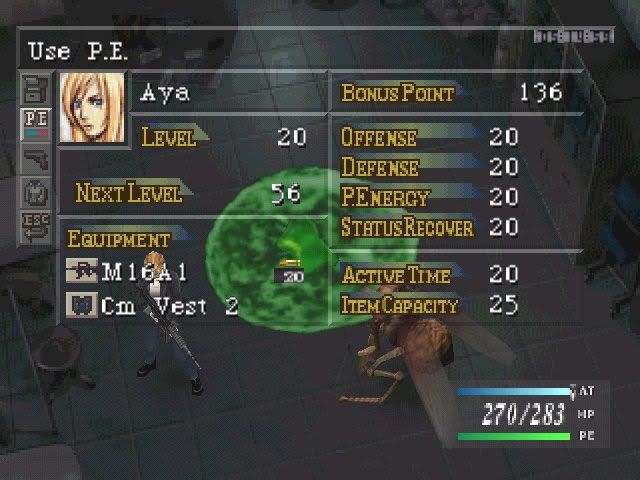
Menu navigation is not too bad but there are a few minor annoyances. One is that to use magic (parasite energy) while in combat you must pull up the entire menu screen, select spells, and then select the spell you want to cast. It's the same for item use as well. While not detrimental to combat itself, as the action is stopped when you take your turn, it still seems like the process could have been streamlined more. Also, in between combat, Aya doesn't reload her gun automatically. If you want to be as fully prepared as possible for the next battle you have to access the menu, go to items, and reload your gun manually.

Parasite Eve offers a few additional gameplay elements to add to the fun. One of the most enjoyable is how you can customize your weapons and armor. During the game you will come across items called "tools". These allow you to take either the bonus stats, or one ability, from a weapon or armor and move it to another. The catch is that the equipment you are moving from is destroyed. For example you can move an ice bullet effect from one gun to another, but in doing so you lose any other bonuses that weapon had. It allows for you to have some fun building the kind of weapon you want with reasonable restrictions. Another fun feature is the distribution of bonus points. Whenever you level up, and after some battles, you will be awarded bonus points which can be spent in a few different ways. You can either raise the stats on a weapon or armor, or use them to speed up your active time gage or add to your item carrying capacity. Oh yes, you are limited to how many items you can carry, very limited. While this a definite annoyance, especially in the beginnings of the game, it does force you to prioritize the items you choose to hold on to. To make this aspect even more frustrating, throughout the game you end up getting non-droppable items given to you by one of the other characters which serve no apparent purpose other than taking up inventory slots.

Overall the game is quite fun, even 10 years after its original release. It's actually a bit disappointing that the completion time is only about 15 hours, making it a pretty short experience for an RPG. However, there is a "New Game +" option that allows you to play through again while retaining your abilities and one weapon and armor from a completed game. There is also a special location available during this mode that provides an additional challenge.

In Summary:
+ Beautiful cinematic presentation
+ Nice blend of action RPG, traditional RPG, and survival horror genres
+ Customizable weapons and armor
+ Repeat playthrough option with bonus challenge location
- Convoluted and sometimes confusing pseudo-science explanation in story
- Stereotyped supporting characters
- Only about 15 hours for first playthrough

I recommend giving Parasite Eve a try especially if you're able to play it on a PSP, as it not only looks great on the small screen but the pacing and length actually make for a good portable game. If you've never played it before you are in for a treat, and if you have, why not take another turn at protecting the Big Apple from the horrors of mitochondria run rampant - you'll be surprised how much fun it still is.

Tuesday, August 26, 2008

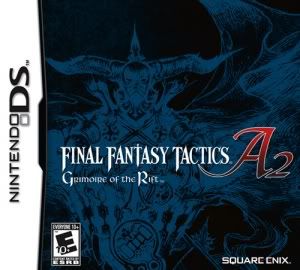
Final Fantasy Tactics A2: Grimoire of the Rift Review - NDS

As a genre, tactical RPGs are a pretty specialized bunch and are aimed at a specific audience of followers. The original Final Fantasy Tactics was one of the greatest examples of this style and a game to which most that came since have been compared to. In a sense, Final Fantasy Tactics A2 falls short of its esteemed predecessor but is still a very strong game with plenty of enjoyment to warrant your investment.

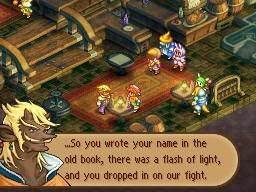
To get right into it, the story in FFTA2 is its weakest point. It it a light and unexciting tale about Luso Clemens, a schoolboy in the real world (our world) who gets transported into the pages of an exotic book. This lands him in the world of Ivalice, the setting used for Final Fantasy Tactics, Final Fantasy Tactics Advance, and Final Fantasy XII. The overarching goal of the game is for Luso to return to his own world but there is no urgency or serious motivation to do so. Even the other goings-on that occur along the way lack any true seriousness or gravity. Perhaps the whole "save the universe" concept so prevalent in RPGs (especially Japanese RPGs) has gotten rather cliche but it sure lends a sense of importance to the events which are happening. Additionally, with the focus on a child as the main character there is a further disconnect for an adult player such as myself. Perhaps Square-Enix is trying to reach out to a broader audience with that decision but I don't think there are a lot of schoolchildren playing tactical RPGs.

Fortunately, the gameplay far outshines this weak story. Of course the main focus in most any tactical RPG is tuning your army and fighting battles and in FFTA2 those elements are wonderful. The class based system used in the previous FFT games is still here and is the best part of this title. You can chose a class (or job for us old-schoolers) for each member of your clan which decides what abilities that individual can learn and also determines some of their basic stats like movement, speed, and evasion. There are a total of 56 classes available, broken down by 6 different races (although it's important to note there is some overlap of abilities and unit types). Not all classes are available to start though, there are some races of units which only become availabe under special conditions and the more advanced classes have prerequisites of minimum ability levels in the more basic classes.

How you actually learn abilities is by wearing equipment imbued with those abilities, with most equipment holding two or three abilities that certain classes can use. By wearing that equipment and being the correct class you immediately gain access to that ability. The longer you wear that equipment while in battle you gain ability points towards learning that skill. Once you earn enough ability points that unit can then use that skill even when not wearing the equipment. (This mechanic should be instantly recognizable to Final Fantasy veterans.)
The best part of this system is once you learn an ability you can even change classes and still have access to equip skills learned under a previous class. Each unit can equip two class action ability groups (such as the White Mage's white white magic abilities or the Soldier's pugilism actions), one reaction ability that triggers when attacked (like counter or regeneration), and one general support ability, (like attack up or turbo MP). This allows for an insane amount of customization once a unit has learned enough abilities. For example, by the end of the game my most powerful unit was a red mage with doublecast (two consecutive magics in a turn), summoner ability, and the blood price support ability (spells cost HP instead of MP at double the price).

The battles in the game are varied and abundant. In addition to the main storyline events your army, or clan, can take on an almost countless number of side quests by accepting jobs at the local pub. A surprising aspect of this is that far from being just throwaway distractions most of these quests had small storylines all their own with recurring characters and consecutive jobs which built upon the prior. For the most part, battles present a decent challenge but the game as a whole felt on the easy side and left me longing for the challenges present in some of the original FFT battles. Thankfully there is also a Hard mode selectable when you begin the game and in hindsight I wish I would have selected that myself. My one gripe about the battle system is that on occasion the enemy AI makes some idiotic choices. This ranges from a wasted turn trying to inflict a status ailment on a unit immune to that ailment to mages with low HP effectively committing suicide my walking up to a fully armored knight with counterattack ability and hitting him. Thankfully these type of things occur only rarely.

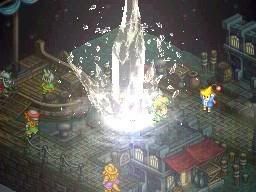
All of this is wrapped up in a very attractive and polished package. The entire game is presented in 2D using well detailed sprites and backgrounds similar to FFTA. However, an impressive upgrade when compared to its predecessor are the spell and ability effects, some of which light up the whole screen with dazzling displays. Being a DS game, the expected touch control is available but it is in no way necessary and I suspect the vast majority of players will skip it all together. Music is very well done and features themes taken from FFXII along with original compositions.

In summary:
+ Beautiful 2D graphics and effects.
+ Expansive selection of unit classes and customization.
+ Huge amount of gameplay.
+ Highly polished presentation.
- Immature and non-engrossing story.
- Occasional poor AI decisions.
- Not all classes are available to start.

Overall FFTA2 is a worthy entry in the FFT series and the tactical RPG genre as a whole. While I still long for the mature storyline and difficulty which was found in the original there is still plenty of deep and engrossing gameplay to justify the easily over 100 hours investment available here.

Sunday, August 24, 2008

A small Final Fantasy Tactics A2 update

After over 110 hours of playing FFTA2 I am nearing completion of the main game. This thing really is huge, especially for a handheld. I have completed may of the additional side-quests which are available throughout the game but there are still a lot left. However, in the interests of moving on play to some other titles before the end of my lifetime I'm just sticking to completing the main storyline. I hope to have the review up Tuesday so keep your eyes peeled.

Thursday, August 14, 2008

PixelJunk Monsters Review - PS3


It's not too often that a game comes along which can captivate audiences across a broad range of ages, skill levels, and even genders. PixelJunk Monsters is one game that can do exactly that. What's better, it can even bring loved ones closer together. Read on to see how this is all possible.

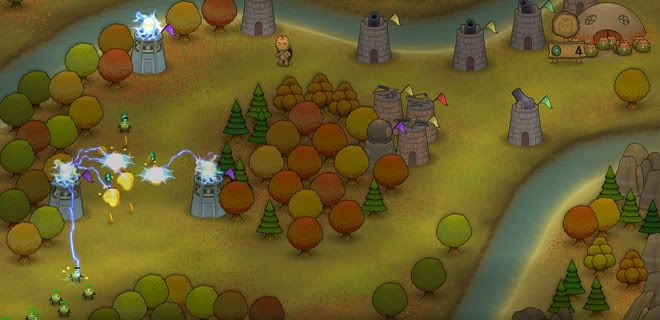
PixelJunk Monsters is a downloadable game from the PlayStation network. It is based on the 'tower defense' genre of games, with examples such as Desktop Tower Defense, Onslaught, and Xeno Tactic. The basic premise is that you are little shaman-looking tribesman tasked with keeping your village of babies (referred to as 'flock' in the game) safe from troops of monsters who just happen to like said babies (the other, other white meat). The way you combat the waves of monsters is by replacing the trees in the forest with defensive towers. There are a variety of towers which have varying effectiveness versus the different types of monsters. For example, fast firing arrow towers are most effective against speedy little spiders but practically bounce right off big lumbering rock golems. For those, you are better off with cannons. Once you throw in the fact there are flying monsters as well which can only be hit by select types of towers you start to get a feel for the strategy involved in keeping all your little babies safe.


While the variety of towers available in the game is great one of my few complaints is that some of the towers are essentially useless, either because they are simply too weak or because they are too expensive to unlock. Oh yes, that's right. Not all of the towers are available to you when you start a level. In order to gain access to the more advanced towers you need to unlock them by spending gems which some of the nasty critters will drop when they die. But wait a second, there's another twist coming. Those same gems can also be spent to upgrade the towers you've already built to make them stronger. Ah ha... such a delicious dilemma. Pay to upgrade that anti-aircraft tower you just built to help kill the oncoming swarm of flying monsters or gamble that your meager defense will hold and save up to unlock laser towers which are even stronger against airborne nasties. One saving grace to help in your dilemma is you can also upgrade your towers by dancing on them. Yes, that's right, dancing. If you just stand still on a tower you have built your little shaman will shake what his mama gave him to somehow invoke the gods of fortification. Dance long enough and your tower will level up, but then again, if you're standing still on a tower you're not building more defenses, now are you? Hmmm... perhaps the dilemma's not lessened after all. Strategic dilemmas are so good, so very good.

An additional challenge is that once you begin to progress past the initial levels you will also start to see monsters with different types of shielding. These shields will render them almost impervious to certain types of towers, helping to keep you honest and not just selling out on one type of defense. While this is a great added element, and you can see when an upcoming wave has shielding, unfortunately there's no way to determine what type of shielding it is. This sometimes leads to a trial and error scenario where you have to wait until the monsters actually arrive on-screen to see if you have been caught with your pants down. Luckily, the game is so enjoyable and the challenges are so varied, trying again is just part of the enjoyment.

I have to say this game is really a perfect conversion of the tower defense style of game for a console. Instead of the hand-of-god mouse cursor plopping down towers you have an actual on-screen character to control. Also, the fact that towers can only be built onto existing tree locations eases console play while adding an additional wrinkle to the challenge (which some stages make a focal point). But hands-down, the best addition a console has brought is the game's inclusion of two player co-operative play. That's right, you can bring a friend along to join in the fun! While you both have full control over building towers and buying upgrades probably one of the best ways to work together is for one player to focus on upgrading the towers while the other handles building new ones. While co-op mode definitely makes the game easier, the overall challenge level of the game is such that it's still not a walk in the park by any means.


To top it all off, all of this gaming goodness is wrapped up in a very attractive package. It sports a unique and distinctive art style which is very cute without going overboard. The music is also original and soothing, helping to ease any frustration that may come from replaying particularly difficult levels. It's an excellent presentation that makes the game accessible just about everyone.

In Summary:
+ Co-op multiplayer!
+ On screen character and pre-set building locations works perfectly for a console.
+ Gameplay presents many strategic dilemmas.
+ Appealing art and musical style.
- Some towers are practically useless.
- No indication of what type of shielding upcoming waves have.

Overall, PixelJunk Monsters is highly recommended. For less than $10 you get a game which will give you, and hopefully a partner, hours of great entertainment. Just be prepared to lose a few hours of sleep as you find yourself trying "just one more time." Still not convinced? Download the free demo and give it a spin. I'm sure you'll be hooked.